Conversation with a Stone
6 December 2025 - 17 January 2026
Opening Reception:
Saturday, December 6, 6-9pm
Curated by Todd Stong
︎ FJORD (1720 N 5th St G2)
Opening Reception:
Saturday, December 6, 6-9pm
Curated by Todd Stong
︎ FJORD (1720 N 5th St G2)
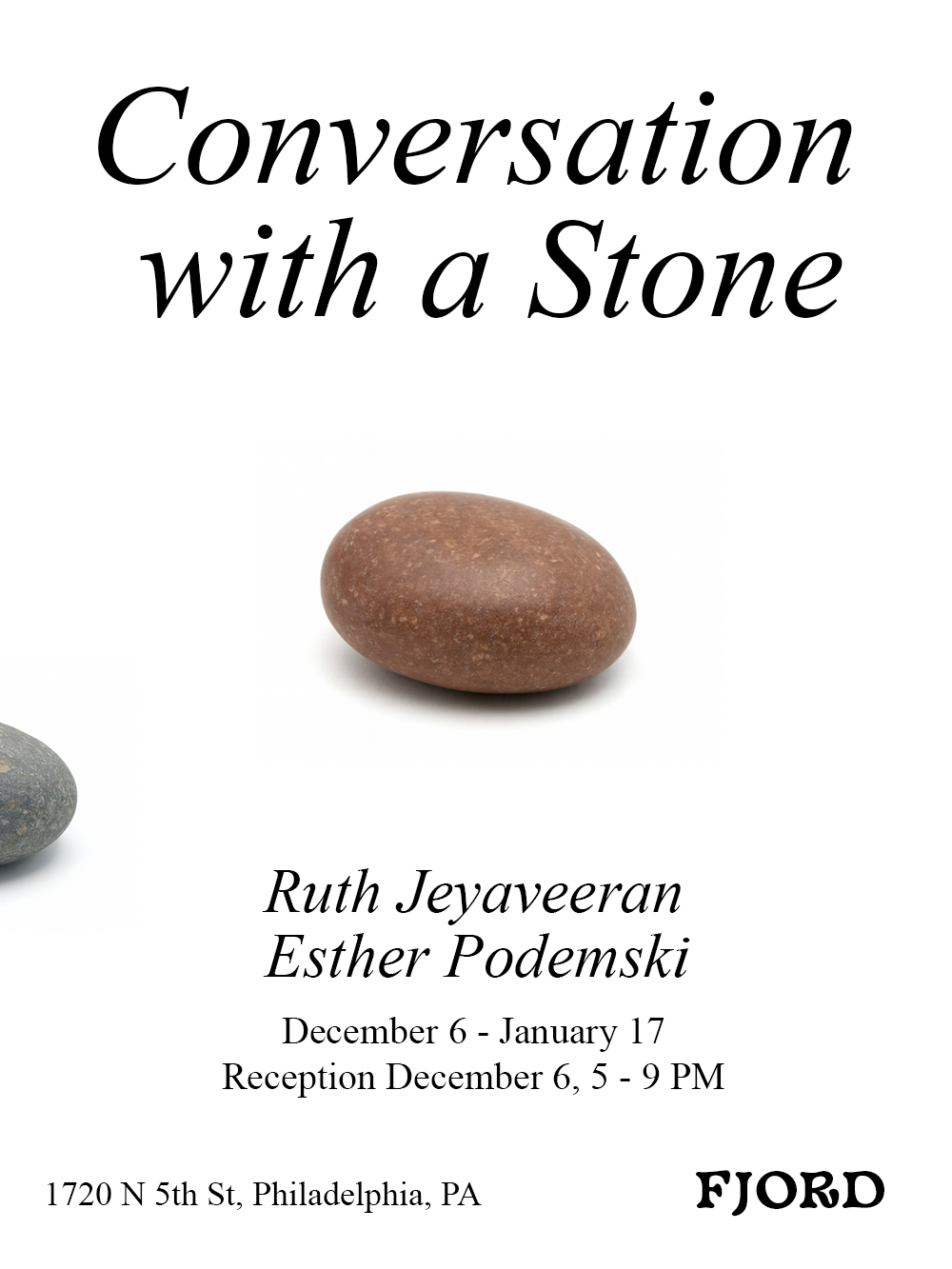
FJORD is pleased to present Conversation with a Stone, an exhibition of Brooklyn-based artists Ruth Jeyaveeran and Esther Podemski, curated by Todd Stong. The exhibition borrows its title from Wislawa Szymborska’s poem, in which a speaker repeatedly asks a stone for entrance. Each time, the stone refuses: “‘You shall not enter,’ the stone says./ ‘You lack the sense of taking part./ No other sense can make up for your missing sense of taking part. / Even sight heightened to become all-seeing / will do you no good without a sense of taking part.’” The poem stages a paradox: the desire to enter where entry is withheld, and the persistence of that desire despite the certainty of refusal. “‘Go away,’ says the stone. / ‘I’m shut tight / Even If you break me to pieces, / we still won’t let you in.’” Broken in half, a stone is not entered; it is made into two.
Both Podemski and Jeyaveeran evoke stone—and the unknown—in different registers and degrees of explicitness. In her Wooly Cairns, Jeyaveeran intuitively builds boulder-like forms from wire and plaster, then encases and stacks them in felted wool, each layer carrying the residue of her touch. The cairn becomes a marker of passage and presence, a gesture of community among travelers who may never meet. Other works engage stone directly: wool cords descend from the ceiling and tether hollow felted forms to rocks at their base. These suspended shapes, suggestive of branches, seedpods, shells, or vertebrae, respond to gravity, tension, and drift, moving like things that have lived alongside the natural world even when their cores have long been removed.
In many of Podemski’s geometric abstractions, a recurring oval, smooth, dark, and stone-like, anchors the composition but never resolves into a single meaning. It derives partly from tantric painting, where such forms serve as sites of contemplation or cosmological orientation. But another source for Podemski’s imagery lies in distorted screenshots captured from color-correction software while she edited her 2011 documentary The Peasant and the Priest. The film follows two elderly Italian men—one resisting corporate agriculture, the other ministering to trafficked women—whose lives intersect with opaque global systems of labor, migration, and precarity. Podemski manipulates these screenshots, then screenprints them directly onto panel, using their digital artifacts as scaffolding. She paints over and through these printed architectures until the compositions evoke airports, stadiums, mapping interfaces: spaces shaped by forces far larger than the individuals moving through them.
Neither artist seeks a singular truth. Jeyaveeran wraps and massages wool with warm water and soap until fibers interlock, threading yarn through surfaces as if drawing across terrain. The resulting lines suggest veins, migration routes, and geologies—a mapping not of place but of pressure, history, and the felt sense of distance. Podemski’s hard-edge abstractions emerge from images already mediated, already strained through documentary practice. She builds spaces that hold multiple temporalities at once, where a line might shift scale abruptly—a boundary becoming a conduit, a conveyor, a horizon.
Conversation with a Stone returns, quietly, to Szymborska’s image: a stone addressed, entreated, turned in the hand, never opened. The works of Jeyaveeran and Podemski rest at that threshold, shaped by touch, labor, and the desire to approach what cannot be fully entered. Their forms linger at the surface, not resigned, but in recognition that the surface is where the world meets us.
About the Artists:
Ruth Jeyaveeran, born in Lusaka, Zambia, and raised in the Midwest, lives and works in Brooklyn, New York. Her first solo show, Soft Remains, was exhibited at Field Projects in 2023. Other recent exhibitions include Felt Experience at the Brattleboro Museum, Communion, a solo installation at Main Window Dumbo, and Amplify, a public sculpture at the Queens Botanical Garden.
Jeyaveeran has exhibited at various venues in and around New York, including Smack Mellon, All Street Gallery, ABC No Rio, Westbeth Gallery, Ely Center of Contemporary Art, The Border Project, Paradice Palase, Bronx Art Space, The Yard, and the Art and Design Gallery at FIT. Her work has been featured in Two Coats of Paint, The Arcade Project, and Art Spiel.
She has been awarded residencies from the Ucross Foundation, the Lower Manhattan Cultural Council on Governors Island, Residency Unlimited, Lighthouse Works, Marble House Project, Jentel Foundation, Willapa Bay, Virginia Center for the Creative Arts, and PADA Studios. Jeyaveeran has taught courses in textiles and fibers at Parsons School of Design, and she frequently leads workshops on felting and the therapeutic benefits of craft. Currently, she is an Associate Professor of Textile Design at the Fashion Institute of Technology.
Esther Podemski is a filmmaker and visual artist whose work has been exhibited in galleries, film festivals, and academic venues. Paintings and drawings have appeared at the Jersey City Museum, the Portland Art Museum, the Jewish Museum (Portland), as well as galleries in New York and other cities, both nationally and internationally. Her work is included in private and public collections. Grants include the New York State Council on the Arts, the Jerome Foundation, the Soros Foundation, the Memorial Foundation for Jewish Culture, the Yaddo Residency, The Virgina Center for the Creative Arts, and Ucross Residency programs. She has taught fine arts graduate and undergraduate courses at Parsons School of Design in New York, Pacific Northwest College of Art, and Sarah Lawrence College.
Of her work in film, a two-screen installation titled “Five Days in July,” revisits the Newark riots of 1967. This installation has shown at numerous museums, galleries and colleges including The Tisch School of Art at NYU, The Birmingham Civil Rights Museum and The Sate Museum in Trenton New Jersey. It won the Director’s Choice award at the Black Maria Film Festival and the Jury Award for the Best Short at The Langston Hughes African American Film Festival. “House of the World,” her documentary about the aftermath of the Holocaust, was shot in Poland and has been showcased in European and American art centers and festivals, including Human Rights Watch International Film Festival, Lincoln Center, and Los Angeles International Jewish Film Festival. Discovery Communication and Jewish Broadcast Network purchased the film for broadcast.Her most recent documentary, The Peasant and the Priest, tells the story of two men in their eighties who are engaged in traditional occupations in modern day Italy. Sergio, a peasant, still works in ancient olive groves; Oreste, a priest, ministers to women caught in global sexual slavery. The point of departure for exploring these parallel lives is a 14th century fresco, The Allegory of Good and Bad Government, by Ambrogio Lorenzetti.